Sleep Science & Comfort
Pillow Loft and Sleep Position: Finding a Supportive Fit
The right pillow height is less about finding a perfect number and more about helping your head and neck settle comfortably in line with the rest of your body. Your usual sleep position, your shape, the way a pillow compresses and even the feel of your mattress can all influence what works.
A pillow that feels wonderfully soft at bedtime may not be supportive once your head sinks into it. The good news: a few simple observations can help you understand what your pillow is doing—and whether a different loft might make rest feel easier.
What does “pillow loft” mean?
Pillow loft is its height, or thickness, when it is resting on the bed. You’ll often see pillows described as low, medium or high loft. Those labels are useful starting points, but they are not precise standards: one brand’s “medium” may be another brand’s “high.” And the height you see on a shelf is not necessarily the height your head will experience during the night.
That difference comes down to compression. When you lie down, the pillow’s fill shifts and gives way beneath your head. A lofty pillow made with soft, compressible fill can settle to a modest height, while a slimmer, firmer pillow may retain more of its shape. For a supportive fit, the important question is not simply how thick the pillow looks. It is how high it stays under your weight, in the position you actually sleep in.
The goal is generally a relaxed, reasonably neutral head and neck position. In practical terms, that means avoiding a pillow that pushes your head sharply upward or lets it fall far downward. Comfort is personal, and no single loft suits everyone, but a pillow that keeps your head from feeling forced into an extreme angle is a sensible place to start.
Why sleep position changes the equation
Your sleeping position affects the space between your head and the mattress. That space is shaped by your shoulders, the width of your head, your posture and how deeply your body settles into the bed. A pillow needs to fill enough of that space to feel supportive without lifting or tipping your head out of a comfortable line.
It’s also normal to change positions during the night. You might start on your side, drift onto your back and wake up turned the other way. Think of your primary sleep position as a guide rather than a rule. If you move around frequently, a pillow with adaptable fill or a middle-of-the-road loft may be more forgiving than one designed around a single posture.
Use the following position-by-position guidance as a starting point. It is not a prescription: individual proportions, mattress feel and pillow construction all matter.
Side sleeping
Side sleepers often need more loft to help fill the space between the outside of the shoulder and the head. A pillow that compresses too much may leave the head dipping toward the mattress; one that stays too tall may push it upward. Look for enough support to keep your head from tilting noticeably toward either shoulder.
Back sleeping
Back sleepers may prefer a lower or medium loft, depending on the pillow and the way their body rests on the mattress. The aim is gentle support, not a steep forward tilt of the head. A pillow that cups the head while leaving the neck comfortable can feel more natural than a very tall, firm cushion.
Stomach sleeping
Stomach sleeping often works better with a low, soft pillow—or, for some people, no pillow beneath the head. A high pillow can turn the head and neck into a more pronounced angle. If you sleep partly on your stomach and partly on your side, consider how well the pillow accommodates both positions.
Side sleepers: filling the shoulder-to-head space
When you lie on your side, your shoulder creates a gap between your head and the mattress. The size of that gap varies considerably. Broader shoulders may call for more pillow height, while a narrower frame may need less. But shoulder width alone does not decide the answer: mattress firmness also affects how much the shoulder sinks into the bed.
On a more yielding mattress, the shoulder may settle farther down, reducing the distance the pillow has to fill. On a firmer surface, the shoulder may stay higher, leaving a larger gap. That is why a pillow that felt right on one bed can feel too tall or too flat on another. Consider the full sleep setup, not only the pillow in isolation.
Try settling into your usual side-sleeping position and notice whether your head seems to tip toward the mattress or away from it. A trusted person can sometimes observe your posture from behind, or you can use a mirror to check your position before settling in. These are only rough checks; the most useful signal is whether you feel relaxed rather than held at an awkward angle.
Some side sleepers like a firmer pillow because it holds its height. Others prefer softer fill that can be shaped around the head. Neither preference is automatically better. What matters is the compressed height and support you get after lying down, not how firm or plush the pillow feels when you squeeze it in your hands.
Back sleepers: support without an exaggerated tilt
Back sleeping usually means less space needs to be filled than side sleeping does, so a very lofty pillow may feel as if it nudges the chin toward the chest. A lower or medium-height pillow can be a comfortable starting point. But a pillow that is too flat may leave your head feeling unsupported, especially if the fill collapses quickly.
Look for a surface that supports the back of your head and feels comfortable around the natural curve of your neck. There is no need to force the neck into a rigid position or to treat a particular posture as ideal for everyone. Instead, notice whether you can settle without having to prop yourself up, tuck your chin down or repeatedly adjust the pillow.
People who switch between back and side sleeping may find a highly adjustable pillow easier to fine-tune. Shredded fill, for example, can sometimes be added or removed, depending on the design. That flexibility can help you test different heights, although adjustment is only useful if the pillow remains comfortable and supportive after its fill has been settled into place.
Stomach sleepers: keeping the profile modest
When you sleep on your stomach, your head is already turned to one side so you can breathe. A thick pillow beneath it may increase the angle. That is why many stomach sleepers prefer a low-loft pillow with a softer feel. Some find that using a pillow under the head is more comfortable than going without one; others prefer a very thin option. Personal comfort and the ability to rest without strain should guide the choice.
If you tend to fall asleep on your stomach but wake on your side, you may need to consider both positions. A low pillow can feel suitable at first but too thin once you roll over. A more adaptable pillow might help, though it may involve some trial and adjustment. If you consistently wake uncomfortable, the answer may involve more than pillow height, including your sleep habits or the overall bed setup.
Pillow fill: why materials change the feel
Two pillows with similar stated dimensions can behave very differently. Fill affects how quickly the pillow compresses, whether it springs back, how easily it can be shaped and how evenly it supports the head. For that reason, pillow fill is part of the loft question—not a separate detail to consider later.
- Down and down alternative: These fills are often soft and moldable. Depending on construction, they can flatten under weight and may need regular fluffing. The feel and amount of support vary by product.
- Feather blends: Feather-filled pillows can often be shaped, but may shift or compress over time. Some people like their adjustable feel; others prefer a more stable surface.
- Memory foam: Solid foam pillows often retain their shape more than loose fills, though their response and firmness vary. Shredded foam versions can usually be molded more easily and may allow height adjustments.
- Latex: Latex pillows are commonly resilient and spring back after pressure is removed. Their feel depends on the pillow’s shape and construction, and some designs are more contouring than others.
- Wool and other natural fills: These materials can have distinct firmness, resilience and temperature characteristics. Construction and care instructions matter, so check how a particular pillow is expected to hold its shape.
Labels and material names cannot tell you exactly how a pillow will feel under your head. If you can, check the return policy and care instructions before buying. A pillow may require a break-in period or regular reshaping, and a washable cover is not the same thing as a pillow that can be machine washed.
The mattress matters, too
A pillow is only one part of the surface your body rests on. If a mattress allows your shoulder or torso to sink deeply, the space your pillow needs to fill may change. If the surface feels firmer and your shoulder settles less, a pillow that seemed high enough elsewhere may suddenly feel too low. These differences can be subtle but noticeable over a full night.
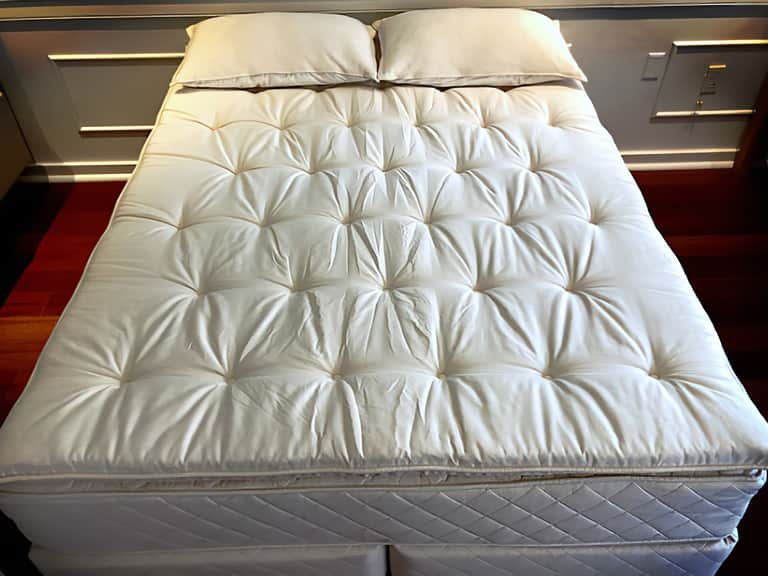
Mattress toppers and thick mattress pads can also alter how your body rests. A cushioned layer may change pressure and sinkage, which can affect your shoulder position. That does not mean you need to replace your mattress to find a better pillow. It simply helps explain why pillow recommendations based on sleep position alone can be too simplistic.
When evaluating pillow loft, test it on the bed you use most often. If you travel frequently or use different sleep surfaces, a pillow that is easy to shape may be convenient. Still, no pillow can compensate for every discomfort, and persistent pain deserves attention beyond a bedding adjustment.
A simple at-home pillow fit check
You do not need specialized equipment to begin assessing a pillow. Give yourself a few quiet minutes in your usual position and observe how it feels after your head has settled. A pillow can seem different after several minutes than it does at the first touch.
- Start with your usual position. Lie down as you normally would, rather than holding an artificial pose for the sake of the test.
- Let the fill settle. Give the pillow time to compress. If it is designed to be reshaped, arrange it in the way you would use it overnight.
- Notice your head angle. Ask whether your head feels tipped upward, dropped downward or comfortably supported. This is a general comfort check, not a medical assessment.
- Pay attention to effort. If you keep tucking, folding or bunching the pillow to get comfortable, its loft or construction may not be working for you.
- Repeat in other positions. If you move during sleep, check the positions you use most. A pillow that feels good only when you remain perfectly still may not be the best match.
- Give changes a little time. A new feel can take some getting used to. But persistent discomfort is a reason to reassess rather than simply assume you must adapt.
Clues your pillow may be a poor match
No single morning symptom proves that a pillow is responsible. Sleep quality, activity, stress and health can all influence how you feel. Still, repeated patterns may be useful clues. You might notice that your pillow flattens during the night, that you wake to reposition it, or that it feels comfortable only when folded into a shape it was not designed to hold.
Other signs are more about the experience of settling in: your head seems perched too high, you feel as though it sinks away from support, or you have to tense your shoulders to find a comfortable position. These observations can help you decide what to test next—perhaps a different loft, a more resilient fill or a pillow that can be adjusted.
Try changing one thing at a time. If you change your pillow, mattress topper and sleep position all at once, it may be hard to tell what made a difference. Keeping a brief note of your usual position, pillow adjustments and morning comfort can reveal a pattern without turning bedtime into a complicated experiment.
Common pillow-loft myths, gently unpacked
“The tallest pillow gives the most support.” Not necessarily. Height is not the same as support. A lofty pillow may collapse substantially, while a lower-profile one can remain firm. How the fill behaves under your head matters more than its appearance.
“There is one best loft for every side sleeper.” Side sleepers often need more height than stomach sleepers, but body shape, shoulder sinkage and pillow compression differ. A universal measurement cannot account for every person and mattress.
“A firmer pillow is always healthier.” Firmness is a preference and a construction feature, not a guarantee of correct fit. A firm pillow can feel too high, just as a soft pillow can collapse too far. Focus on comfort and the way the pillow holds its height in use.
“If a pillow is expensive, it will solve the problem.” Price does not establish that a pillow is suited to your sleep position or personal comfort. A clear description of materials, loft, adjustability, care and return terms is more useful than a premium label by itself.
When comfort concerns call for extra help
A pillow adjustment may help with ordinary comfort, but it is not a treatment for a medical condition. If you have persistent or worsening neck pain, numbness, tingling, weakness, frequent headaches or pain that interferes with daily life, consider discussing it with a qualified health professional. Seek medical advice promptly for severe or sudden symptoms, or symptoms that follow an injury.
People with diagnosed neck or spine conditions may have individual needs that differ from general bedding guidance. A clinician can offer advice tailored to your situation. The same applies if sleep is regularly disrupted by breathing problems, significant discomfort or other symptoms that concern you.
Finding your supportive fit, one adjustment at a time
Choosing pillow loft is a small but personal piece of the sleep puzzle. Side sleepers often start by looking for enough height to fill the shoulder-to-head gap. Back sleepers commonly explore lower or medium profiles that do not push the head too far forward. Stomach sleepers often prefer a low, soft pillow to avoid adding unnecessary height.
Those are starting points, not rules. Your body, sleep position, mattress and pillow fill work together. A pillow’s advertised height may not match its compressed height, and a material that holds its shape for one person may feel too firm or too soft for another. The most useful test is how comfortably the pillow supports you in your real sleep setup.
Give yourself permission to make a measured adjustment rather than chasing a mythical perfect pillow. Notice how the pillow settles, whether you can relax without constantly rearranging it and how it feels across the positions you actually use. With a little attention, the right loft becomes less of a guess and more of a practical, comfortable fit.